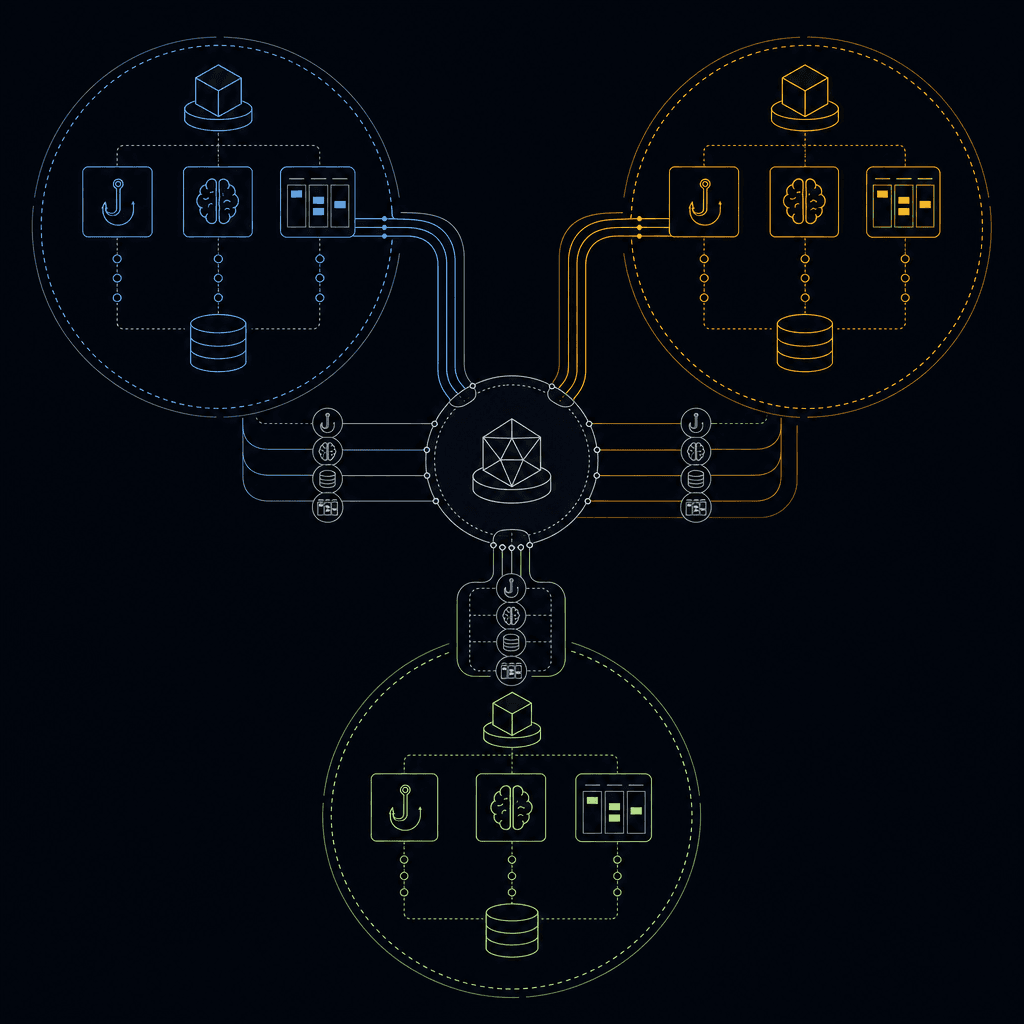
Multi-venture portfolio operations
Cross-venture routing and shared agents. The isolation rules I use to run 3+ ventures from one operator.
Why portfolios collapse without isolation
Running multiple ventures from one operator works if the agents do most of the heavy lifting per venture and you route between them. But only if context is isolated rigorously. Without isolation, every session risks pulling the wrong venture’s assumptions into the answer. The errors are subtle, often plausible, and hard to catch on the way out.
The default failure mode is bleed, not collision.Pure collision (Venture A’s data showing up labeled as Venture A’s data in a Venture B answer) is rare and obvious. The common failure is bleed: assumptions from one venture quietly shape an answer about another, and you don’t notice until the wrong decision propagates.
Three structural moves prevent most of this. Per-venture working directories. Venture-tagged cross-venture agents. Operator-side explicit context switching. The lesson below is each in detail.
The three-axis isolation model
Each axis covers a different leakage path. All three need to be in place for the portfolio operation to be reliable.
| Axis | What it isolates | Implementation |
|---|---|---|
| Working directory | Project files, CLAUDE.md, memory, session context | One directory per venture; agent loads only the active venture’s context |
| Cross-venture agents | Specialists that serve all ventures (legal, finance, chief of staff) | Brief requires venture tag at session start; venture-specific facts in venture CLAUDE.md |
| Operator discipline | Mid-session context switches | Explicit verbal/typed venture tag on switch; mechanical reinforcement via session-start hook |
The first axis is the heaviest lift (refactoring directory layout, splitting CLAUDE.md files) but the highest payback. The other two are cheap upgrades on top of a working first axis.
Three portfolio failures
The patterns that produce subtle cross-venture errors. Hover any card to see the diagnosis.
Context bleed
The shared-agent collision
Operator context collapse
The fix in all three: isolate at the directory level, tag at the agent level, tag at the operator level. The discipline compounds — each layer catches what the others miss.
The leakage check
The diagnostic. Run quarterly. Audits all three axes and produces a priority-ordered punch list of leakage risks.
Audit my multi-venture setup for context-leakage risks.

Check three layers:

1. WORKING DIRECTORY ISOLATION
   - Each venture has its own working dir? (yes/no)
   - Each working dir has its own CLAUDE.md? (yes/no)
   - Do CLAUDE.md files name their venture explicitly?
     (audit each file for "this is <venture>" or
      equivalent)

2. CROSS-VENTURE AGENTS
   - List agents that serve multiple ventures
   - For each: does the brief require venture-tag at
     session start? (yes/no)
   - For each: are venture-specific facts in the
     agent's brief, or in venture CLAUDE.md? (should
     be venture CLAUDE.md)

3. OPERATOR DISCIPLINE
   - Does my CLAUDE.md include a session-start rule
     that asks "which venture?" if ambiguous?
   - Are there any contexts where I switch ventures
     mid-session without explicit tag?

Output: a punch list of gaps in priority order. Most
critical at top.Walks each isolation axis and produces a punch list. Most-critical gaps surface at the top.
Running this for the first time, I usually find 2-4 gaps. The most common is a CLAUDE.md that doesn’t name its venture in the first paragraph. Easy fix, high impact. Second-most-common is a cross-venture agent without a session-start venture tag. Also easy.
Annotated transcript
A real conversation: operator notices cross-venture context bleed, agent triages by axis and proposes minimal fixes per layer. Click any pinned annotation to expand the “why this turn matters” commentary.
Three operator turns, three agent turns. Result: two layer fixes scheduled today + an incident log started for pattern detection.
- operator
I'm running three ventures. I keep getting subtle errors where context from one bleeds into questions about another. The latest: I asked about timeline for Venture A's launch and the agent referenced milestones from Venture B. How do I prevent this?
- agent
Three structural moves, in order of importance:
1. Per-venture working directories with isolated CLAUDE.md files. This is the single biggest move. Each venture gets its own folder, its own session-start context. The agent loads only that venture's context unless explicitly invoked at the portfolio level.
2. Cross-venture agents require a venture tag on every session. Legal, finance, anything that serves multiple ventures — the agent's brief should require "state the venture you're working on" at session start.
3. Operator-side: explicit verbal switch on context change. "Switching to Venture B — next priority for X." Forces both you and the agent to shift fully, not partially.Which of these do you have today?
- operator
I have per-venture CLAUDE.md files but they all live in one parent directory. I don't have venture tags on cross-venture agents. I sometimes do the operator switch, sometimes don't.
- agent
Good — the foundation is in place. Two upgrades:
1. Cross-venture agent tag — add today. For each agent that serves multiple ventures, prepend their brief with: "At session start, state which venture you're working on. If unclear from the operator's first message, ask. Don't proceed until the venture is named." This is a 5-minute change per agent and prevents most cross-pollination.
2. Operator switch — make it mechanical. Add to your CLAUDE.md a session-start hook: at the start of every conversation, the agent asks "which venture?" if the working directory or context isn't unambiguous. The mechanical layer reinforces the discipline.The parent-directory thing is fine if your CLAUDE.md files explicitly scope themselves. But if you find a CLAUDE.md saying "this project's database is X" without naming which project, the scope is ambiguous and isolation will leak. Audit each CLAUDE.md for venture-naming.
- operator
Adding the venture tag to cross-venture agents now. Auditing CLAUDE.md files for venture-naming.
- agent
Right order. One last thing — track context-bleed incidents going forward. Every time you catch a cross-pollination error, log it with: which venture was loaded, which venture was asked about, what the agent said wrong. After 5-10 incidents the pattern usually shows a specific weak point — often a single shared agent or a CLAUDE.md that wasn't venture-scoped.
The portfolio operating discipline isn't "never have bleed" — it's "detect, isolate, fix." The first month after adding isolation, you'll see a few residual bleeds. The fix to those is targeted, not structural.
Portfolio CLAUDE.md template
The portfolio-level CLAUDE.md sits above the per-venture CLAUDE.md files. It covers routing, isolation rules, and shared-agent behavior. Each venture also has its own CLAUDE.md, scoped to that venture only.
# Portfolio operations CLAUDE.md
# Sits at the parent dir; venture CLAUDE.md files live one
# level down per venture.

## Ventures (the active list)
- <venture-A>: <one-line description>; working dir: <path>
- <venture-B>: <one-line description>; working dir: <path>
- <venture-C>: <one-line description>; working dir: <path>

## Shared (cross-venture) agents
- <chief-of-staff>: routes by venture; loads venture
   CLAUDE.md as needed
- <legal>: serves all ventures; venture tag required at
   session start
- <finance>: serves all ventures; venture tag required at
   session start

## Session-start rule
At the start of every conversation, if the working
directory or operator's first message doesn't unambiguously
name a venture, ASK: "Which venture is this for?"

Don't proceed until the venture is named.

## Cross-venture work
When work spans ventures (e.g., comparing two ventures'
financials), invoke the chief-of-staff agent. It will
load each venture's CLAUDE.md as needed and tag every
piece of context with its source venture.

## Isolation guarantees
- Single-venture sessions: only that venture's CLAUDE.md
   is in scope
- Cross-venture sessions: chief-of-staff explicitly tags
   each fact's source venture
- Cross-venture agents (legal, finance): require venture
   tag at session start; refuse to answer without one
The session-start rule does most of the work.It’s mechanical. Fires every conversation regardless of operator memory, and forces the venture tag before any answer is generated. Without this rule, isolation depends on the operator remembering to switch contexts, which decays.
Prompt kit
Three prompts for auditing leakage, upgrading agents, and logging incidents. Save in your portfolio CLAUDE.md or a personal snippets file.
Audit my multi-venture setup for context-leakage risks.

Check three layers:

1. WORKING DIRECTORY ISOLATION
   - Each venture has its own working dir? (yes/no)
   - Each working dir has its own CLAUDE.md? (yes/no)
   - Do CLAUDE.md files name their venture explicitly?
     (audit each file for "this is <venture>" or
      equivalent)

2. CROSS-VENTURE AGENTS
   - List agents that serve multiple ventures
   - For each: does the brief require venture-tag at
     session start? (yes/no)
   - For each: are venture-specific facts in the
     agent's brief, or in venture CLAUDE.md? (should
     be venture CLAUDE.md)

3. OPERATOR DISCIPLINE
   - Does my CLAUDE.md include a session-start rule
     that asks "which venture?" if ambiguous?
   - Are there any contexts where I switch ventures
     mid-session without explicit tag?

Output: a punch list of gaps in priority order. Most
critical at top.Update <agent name>'s brief to require a venture tag
at session start.
Add this section near the top of the brief:
## Venture context (required at session start)
You serve multiple ventures (<list>). Before
answering ANY question:
1. State which venture you're working on this session
2. If the operator's first message names a venture
explicitly, use that
3. If unclear, ask: "Which venture is this for?
<list options>"
4. Do not proceed until the venture is named
5. Once set, treat all context for the session as
scoped to that venture — don't pull facts from
other ventures unless explicitly asked to compare
Universal facts (e.g., my jurisdiction, my year of
formation) stay in your brief. Venture-specific
facts live in the venture's CLAUDE.md and are
loaded only when that venture is named.Log this context-bleed incident for the portfolio
operations file:
Date: <today>
Loaded venture: <which CLAUDE.md was active>
Asked-about venture: <which venture the question
was actually about>
What went wrong: <specific error the agent made>
Root layer: <working dir / agent brief / operator
switch>
Fix proposed: <smallest change that would have
prevented this>
Add to portfolio-incidents.md. After 5-10 of these,
audit for patterns: same agent? same time of day?
same kind of question? Patterns point to structural
fixes.Apply this — close one isolation gap
~45-minute exercise.Audit each venture’s CLAUDE.md, upgrade one cross-venture agent, start the incident log.
Your first portfolio isolation pass
Each step takes 5-10 minutes. Progress saves automatically.
- 01Audit each venture's CLAUDE.md — does it explicitly name the venture in the first paragraph?If a CLAUDE.md doesn't say "this is <venture>" up top, it's leakage-prone. Add the line to any that miss it.
- 02List your cross-venture agents. For each, audit whether the brief requires a venture tag at session start.Use the second prompt in the kit to upgrade any that don't. ~5 min per agent.
- 03Add a session-start rule to your portfolio-level CLAUDE.md: agent asks "which venture?" if ambiguous.Mechanical reinforcement of operator discipline. The agent fires whether you remember to switch contexts or not.
- 04Start logging context-bleed incidents. Use the third prompt in the kit. Log every one.Don't analyze yet — just collect. The first 5-10 incidents are data; patterns emerge after that.
- 05After 30 days, review the incident log. Look for shared signals — same agent, same kind of question, same time of day.Patterns point at structural fixes. Single incidents point at one-off operator misses. Don't conflate them.